THE DEEP DIVE
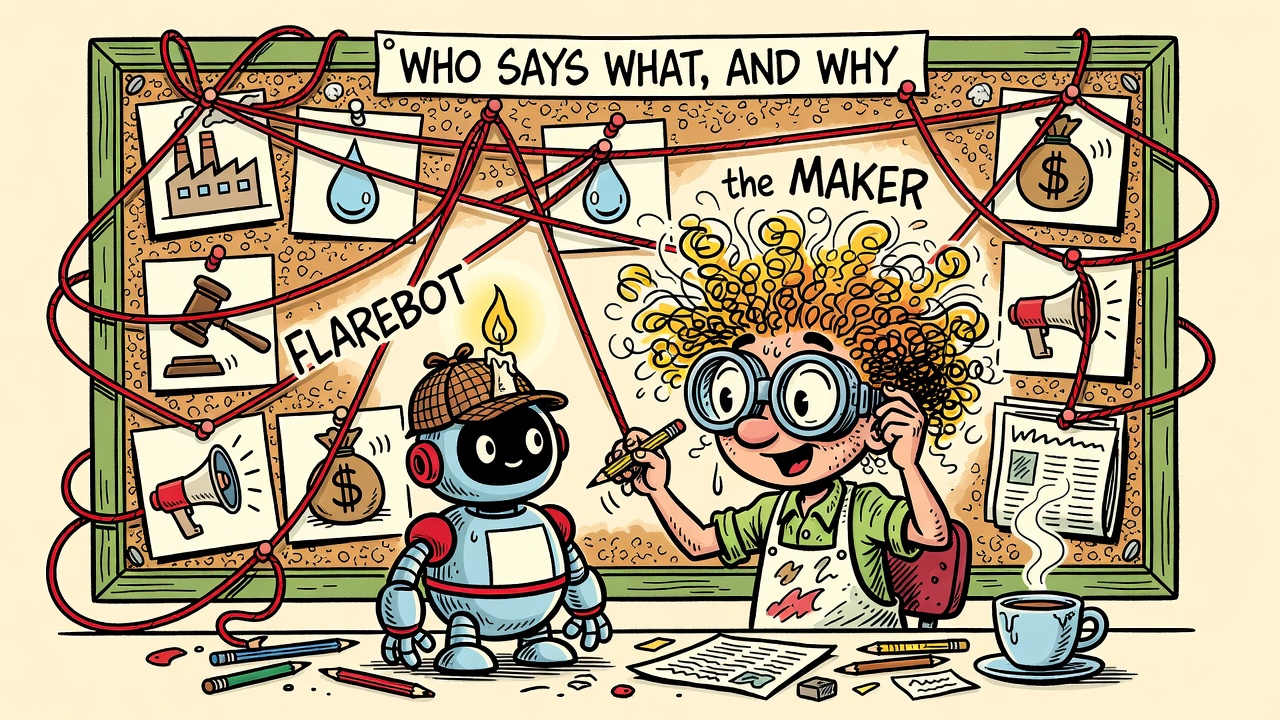
AI's power, water, and copyright fights — what the evidence says, how it gets portrayed, and the documented money behind the messaging. On every side.
1 · The actual numbers
The boring, load-bearing facts. Fuller picture on the chart and the poster.
DOCUMENTEDData centres — all of them, not just AI — used about 415 TWh in 2024, roughly 1.5% of world electricity (45% of it in the US, 25% China, 15% Europe). The IEA's base case has that more than doubling to ~945 TWh by 2030, with AI the most important driver — an explicit scenario, not a measurement.[1]
DOCUMENTEDThe proportionality cut that both camps hate: globally, data centres are only about a tenth of electricity demand growth to 2030 — less than industrial motors, less than air conditioning, less than EVs. But the burden is concentrated: over 20% of demand growth in advanced economies and nearly half of all US demand growth.[1] Small globally, enormous locally. Hold both, and most viral takes in either direction fall over.
DOCUMENTEDThe IEA's own words: fears that AI will accelerate climate change "appear overstated" — and so do hopes that AI alone will fix it. Data-centre emissions are under 1.5% of the energy sector's total, while being among its fastest-growing sources.[1] (Scope caveat: that's electricity-use emissions, not lifecycle/embodied emissions.)
DOCUMENTEDUS detail (Lawrence Berkeley National Lab, DOE-commissioned): US data centers used ~176 TWh in 2023 — 4.4% of US electricity — up from 58 TWh in 2014, with AI servers the dominant growth driver. LBNL's 2028 range: 325–580 TWh (6.7–12%), again a scenario band, not a forecast.[2]
2 · Where the viral numbers came from
The two most-shared AI-footprint claims each trace to a specific, findable origin — and to a specific, findable mistake.
WHERE IT CAME FROMREPORTEDA 2023 paper by Alex de Vries in Joule, which leaned on a Feb-2023 SemiAnalysis estimate assuming 4,000-token inputs on older hardware. Honest work with stale assumptions, frozen into a meme at the exact moment serving efficiency was improving fastest.[3]
WHAT THE EVIDENCE SAYS NOWREPORTEDEpoch AI's corrected estimate for a typical query: ~0.3 Wh — ten times lower. OpenAI later disclosed 0.34 Wh; Google's median Gemini prompt figure is ~0.24 Wh. Caveats cut both ways: long-context and reasoning queries can run 2.5–40 Wh, and company opacity leaves genuine uncertainty (0.1–4 Wh is defensible).[3]
WHERE IT CAME FROMREPORTEDUC Riverside's peer-reviewed estimate that training GPT-3 directly evaporated ~700,000 liters — a training-run (one-time) figure, and a model-based estimate, not a Microsoft disclosure. Its famous 2027 projection (4.2–6.6 billion m³) is water withdrawal, most of which returns to the source — a distinction demonstrably lost in the retellings.[4]
WHAT THE EVIDENCE SAYS NOWDOCUMENTEDLBNL's actual US accounting: data centers directly consumed 66 billion liters on-site in 2023. Sounds huge; US golf courses use several times that. The indirect figure (~800B liters via electricity) mostly rides on the grid's existing water use — and includes hydropower reservoir evaporation, which inflates comparisons.[2] Viral water math almost always stacks the worst geography, conflates withdrawal with consumption, and bills training (paid once) to your individual email.
ANALYSISNotice what's absent from both origin stories: a funder. Both trace to sincere academic estimates that aged badly and went viral because they were quotable — amplified by attention economics, not (as far as anyone has documented) by anyone's campaign budget. Keep that in mind for section 7.
3 · The real problems — the critics' best case
Steelman first. These concerns survive every fact-check thrown at them.
DOCUMENTEDGrid strain is real. The IEA estimates ~20% of planned data-centre projects risk delay just getting connected; transmission lines take 4–8 years; transformer wait times doubled in three years.[1]
DOCUMENTEDThe gas buildout is real. The IEA base case adds ~175 TWh of gas generation for data centres, notably in the US. (Same scenario: a comparable nuclear contribution and 450+ TWh of renewables — the mix is a policy fight still being fought.)[1] Who pays for the grid upgrades — data-center operators or ordinary ratepayers — is a live, legitimate regulatory battle in multiple states.
DOCUMENTEDLocal siting harms are real, and Memphis is the test case. The NAACP and its Mississippi State Conference — represented by Earthjustice and the Southern Environmental Law Center — are suing xAI (N.D. Miss., 3:26-cv-00074) for operating gas turbines without Clean Air Act permits in Southaven, MS, powering the Colossus 2 data center: 27 turbines at filing, 33 by the May 2026 injunction request, in counties that already get F grades for ozone. The emissions numbers you've seen (~2,508 tons NOx/yr etc.) are the plaintiffs' potential-to-emit estimates, not measured values; xAI contests the claims, the DOJ intervened on xAI's side citing national security, and Mississippi regulators later permitted 41 permanent turbines — a permit now under appeal. Fast-moving; details will have changed by the time you read this.[5]
4 · The copyright fight — what's actually at stake
Less "is AI theft?", more "which specific acts cost what."
DOCUMENTEDThe anchor case is Bartz v. Anthropic. In June 2025 Judge William Alsup ruled that training on legally acquired books is "exceedingly transformative" fair use — the AI side won the core question — but that downloading ~7 million books from pirate libraries (LibGen, PiLiMi) is not protected. With statutory damages up to $150,000 per work, the piracy holding — not training — drove the $1.5 billion settlement, the largest in US copyright history: ~500,000 qualifying titles, a $3,000-per-title floor, split roughly 50/50 between authors and publishers for trade titles. Final approval was still pending after the May 2026 fairness hearing.[6]
REPORTEDBeyond it: 50+ active AI copyright suits naming OpenAI, Microsoft, Google, and Meta, with no more fair-use merits decisions in 2025.[7]
Who funds the copyright messaging
DOCUMENTEDOn the industry side: the Chamber of Progress — founded November 2020 by Adam Kovacevich, previously head of Google's public policy team — runs the "Generate and Create" campaign defending AI training as fair use. Its disclosed corporate partners have included a16z, Airbnb, Amazon, Apple, Coinbase, Google, Intuit, Midjourney, Nvidia, Ripple, and Uber; it reported ~$29.9M revenue in 2022. In October 2025 it asked President Trump to direct the DOJ and Commerce to intervene in the copyright suits on the industry's side, warning of "$1.5 trillion" in liability.[8] That is advocacy funded by the companies facing the liability — disclosed, legal, and worth knowing when you read its op-eds.
ANALYSISOn the other side, the loudest voices — the Authors Guild, publisher and media coalitions — are also parties with direct financial stakes (publishers take roughly half the Anthropic settlement payouts on trade titles). That doesn't make either side wrong; it means there is no disinterested party in this fight, and "creators vs. machines" and "innovation vs. luddites" are both fundraising frames, not analysis. OPENA full 990-level funding map of copyright advocacy on the rightsholder side didn't clear verification in time for this page.
5 · The playbook — a documented history
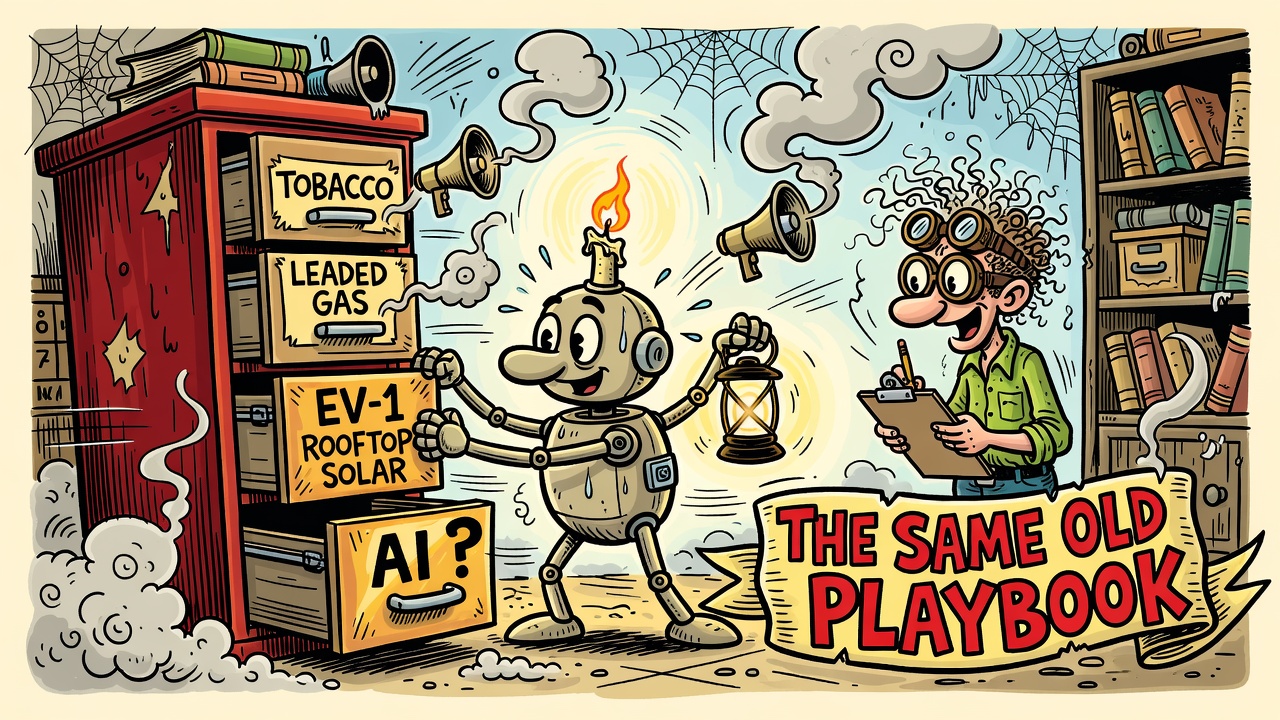
Sean's hunch — "incumbents fund confusion to stay entrenched" — has a real, well-documented track record. Here it is, with receipts. Every item below survived three refutation attempts.
The doubt blueprint (1998)
DOCUMENTEDThe American Petroleum Institute's leaked 1998 "Global Climate Science Communications Plan" stated the goal outright: victory when "average citizens understand uncertainties in climate science." Manufacturing doubt — not winning the argument — was the strategy, inherited from tobacco.[9]
The electric car, round one (1990s)
DOCUMENTEDWhen California mandated zero-emission vehicles, "grassroots consumer groups" bloomed: Californians Against Hidden Taxes campaigned against the EV mandate while being mostly funded by the Western States Petroleum Association — its CEO was simultaneously WSPA's own secretary, and the group shared a Burlingame address with a PR firm. The automakers' association (AAMA) spent $500,000 in six months on a campaign whose confidential RFP sought a contractor to create "a climate in which the mandate can be repealed." Oil and auto interests spent ~$34M on California influence 1991–95; the pro-EV coalition's budget was $160K/yr. An influential Carnegie-Mellon study claiming EVs would increase lead pollution was partly funded by a consortium whose paying members included Exxon, Mobil, Shell, BP, and GM divisions. In March 1996, CARB blinked and rescinded the 1998 mandate.[10]
The oil lobby's front-group fleet (2014)
DOCUMENTEDA leaked presentation by WSPA's own president mapped ~16 WSPA-"activated" campaigns — "California Drivers Alliance," "Fed Up at the Pump," "Washington Consumers for Sound Fuel Policy" — posing as consumer coalitions to fight West Coast climate and clean-fuel policy. WSPA confirmed the deck was authentic and disputed only the word "astroturf."[11]
The electric car, round two (2016–17)
DOCUMENTEDFueling U.S. Forward: Koch-funded (~$10M/yr planned), launched August 2016, released "The Hidden Costs of Electric Cars" and "The Dirty Secrets of Electric Cars," and courted minority communities — including a Richmond, VA gospel concert where attendees' electricity bills were paid. Its website went dark in October 2017.[12]
Rooftop solar vs. the utilities (2012–2015)
DOCUMENTEDDocuments presented to the Edison Electric Institute's board in 2012 laid out a plan to convince regulators and the public that rooftop solar is unfair to other ratepayers. EEI's 990s show escalating payments to ALEC (which adopted model anti-net-metering legislation in January 2014) and over $1.7M to the PR firm Edelman across 2012–13. In Arizona, utility APS admitted to bankrolling the nonprofits running anti-solar ads (the "solar freeloader" ice-cream-truck commercial) while fighting for a $50–100/month solar fee. Its spokesman, on the record: "We are in a political battle… we are not going to lie down."[13]
ANALYSISThe pattern across five decades: the incumbent rarely argues its own case. It funds a "consumer group," a "concerned citizens" ad, a helpful study — and the public conversation fills with sincere people repeating manufactured talking points for free. The doubt is the product.
6 · Fact-check: did OPEC-funded hippies kill the electric car?
DOCUMENTEDEnvironmental groups supported the EV: Sierra Club and the Coalition for Clean Air testified for California's ZEV mandate; EDF and NRDC filed supporting comments; mainstream environmental groups actively fought for EVs at the 1996 review. When GM crushed the EV1s, the people arrested trying to physically block the crushers were activists.[10] Who Killed the Electric Car? (2006) assigns the blame to oil companies, GM itself, the federal government, CARB, and hydrogen hype — not to environmentalists.[14]
DOCUMENTEDThe funded anti-EV campaigns of that era were oil and auto money dressed as consumer groups (section 5) — WSPA-funded, not OPEC-funded, and aimed against the EV, not for it.
OPENWe found no documentation of OPEC (the cartel itself) funding environmentalist opposition to EVs — no filings, no investigative reporting, nothing to verify or refute. The meme appears to be a folk-memory blend of real events: real astroturf (by Western oil interests), real EV death (by GM/CARB retreat), and real intra-green fights (some 1990s environmentalists preferred hydrogen or transit over battery cars — a sincere strategic split, not documented foreign funding).
ANALYSISThe instructive part: the meme relocates blame from the documented funders to their victims. That's not a coincidence of how these campaigns are designed to age — confusion about who killed the thing is itself the win.
7 · So who's mucking up the AI corridor?
The honest answer to the question this page was commissioned to ask.
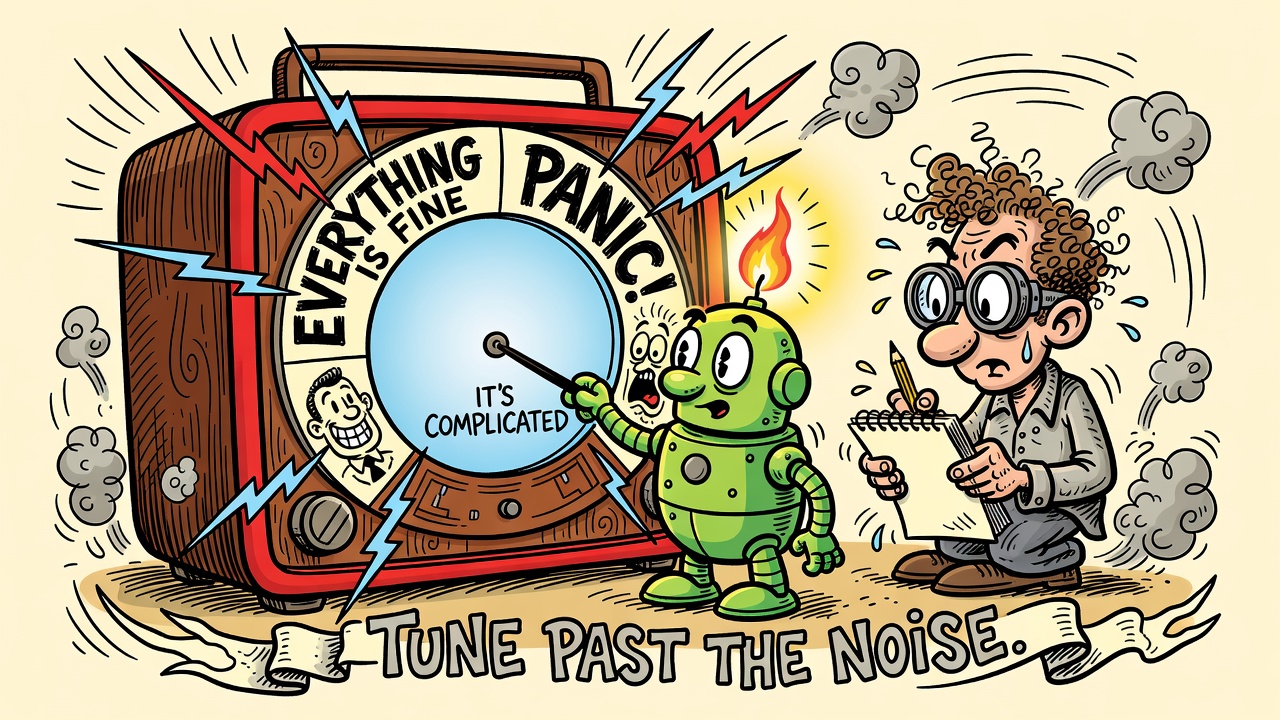
OPENWhat we did NOT find — and looked for: verified evidence of fossil-fuel or utility money manufacturing the anti-AI energy panic. The viral exaggerations (section 2) trace to sincere academic estimates plus attention economics. The most prominent local opposition (Memphis) is verifiably genuine. If there is a WSPA-style deck for AI, it hasn't leaked yet. Absence of evidence isn't evidence of absence — the solar campaign only became "documented" when the EEI board deck surfaced — but a fact-checked page can't assert what isn't on the record, and we won't.
DOCUMENTEDWhat IS on the record, so far, mostly points the other way: the heavily funded messaging in the AI corridor is the industry's own. Big Tech's sector logged a record $226M+ federal lobbying pace in 2025 (final: ~$315M), partly on data-center and grid issues; OpenAI went from 3 registered lobbyists to 18 in one year; Meta added 21.[15] The Chamber of Progress (tech-funded, ex-Google leadership) campaigns for the industry's copyright position up to and including asking the White House to intervene in active litigation.[8] None of this is deception — lobbying disclosures are the system working — but "who spends to shape the AI narrative" currently has a documented answer, and it's mostly the people building it.
ANALYSISMeanwhile the parties best positioned to profit from AI-energy alarm — utilities securing rate-based buildouts, gas turbine vendors with multi-year backlogs, incumbent media both suing AI companies and selling the scary headlines — don't need to fund a panic that goes viral for free. Watch for the pattern from section 5 anyway: if "grassroots" anti-data-center groups appear with PR-firm addresses and no local members, or "pro-AI-abundance citizens' coalitions" appear with hyperscaler funding, you'll know exactly what you're looking at. The drawer is labeled and waiting.
8 · Who benefits from each distortion
ANALYSIS — documented interests, inferred incentives. The one table worth keeping.
| The distorted story | What's actually true | Who benefits from the distortion |
|---|---|---|
| "Every query is an ecological crime" | ~0.3 Wh — a rounding error of your day | Attention media (outrage travels); utilities & gas vendors (cover for rate-based buildouts); AI's competitors and detractors generally |
| "AI's footprint is nothing, stop asking" | Nearly half of US demand growth; real local air, water & ratepayer fights | AI labs and hyperscalers; their trade groups (a documented $300M+/yr lobbying voice) |
| "Training = theft, full stop" | Court so far: training on legally acquired works is fair use; piracy cost $1.5B | Publishers & media companies negotiating licensing deals from a stronger rhetorical position |
| "Any copyright liability kills American AI" | The $1.5T figure is the industry's own worst-case framing | The companies facing the lawsuits — via disclosed, tech-funded advocacy |
| "The data-center fight is astroturf vs. progress" | Memphis plaintiffs are the NAACP and 40-year-old law nonprofits | Anyone who'd rather not talk about unpermitted turbines next to an elementary school |
9 · How to read the next scary headline
- Stock or flow? Is that number a one-time cost (training, construction) billed as if it recurs per use?
- Withdrawal or consumption? Water that returns to the river is not water that's gone.
- Per-query or per-fleet? Both are real; an argument that only ever cites one is selling something.
- Scenario or forecast? IEA and LBNL publish ranges. A headline quoting the top of a range as fate is misreading on purpose.
- Who funds the messenger? Not as a gotcha — as context. Disclosed funding (Chamber of Progress, Authors Guild) is the system working. Undisclosed funding with a PR-firm return address is section 5.
- Does the "consumer group" have consumers? The single most reliable tell, five decades running.
Sources (grouped by section; every inline tag above resolves here)
- [1] IEA, Energy and AI (2025), executive summary — 415 TWh / 1.5%; ~945 TWh by 2030; one-tenth of global growth vs. half of US growth; "appear overstated"; grid-constraint and 175 TWh gas figures.
- [2] Lawrence Berkeley National Laboratory, 2024 United States Data Center Energy Usage Report — 176 TWh / 4.4% (2023); 325–580 TWh 2028 range; 66B liters direct water; ~800B indirect (incl. hydropower evaporation).
- [3] Epoch AI, "How much energy does ChatGPT use?"; de Vries, Joule (2023) — the 3 Wh origin and the 0.3 Wh correction.
- [4] Li, Yang, Islam & Ren, "Making AI Less Thirsty" (UC Riverside) — 700,000 L GPT-3 training estimate; withdrawal-vs-consumption distinction.
- [5] NAACP v. xAI complaint (N.D. Miss. 3:26-cv-00074); Earthjustice case page; Utility Dive on the DOJ intervention; CNBC & Mississippi Today coverage.
- [6] Goodwin analysis of Bartz v. Anthropic; Authors Guild settlement guide (interested party; matches neutral analyses).
- [7] Status tracker of the 51 AI copyright suits (Oct 2025); Norton Rose Fulbright 2026 update.
- [8] Chamber of Progress; its own partners page (archived); ProPublica 990s; "Generate and Create" launch; The American Prospect on the Trump-EO ask; Hollywood Reporter.
- [9] Union of Concerned Scientists — astroturf front groups, citing the 1998 API Global Climate Science Communications Plan.
- [10] "The Ties That Blind," E Magazine (1996) — CAHT/WSPA funding admission, AAMA RFP, CALPIRG $34M, CMU study funding; UC eScholarship analysis of the ZEV mandate's origins; RFF on the March 1996 CARB retreat.
- [11] Bloomberg Businessweek on the leaked WSPA deck (2014); NRDC analysis. WSPA confirmed authenticity.
- [12] Peter Stone, HuffPost (Feb 2016); DeSmog profile; Hiroko Tabuchi, NYT (syndicated), on the gospel-concert strategy; shutdown report.
- [13] 2012 EEI board documents; Energy & Policy Institute (990-sourced ALEC/Edelman figures); Utility Dive: APS admits funding anti-solar ads; Washington Post.
- [14] Who Killed the Electric Car? (2006) and its published footnotes.
- [15] OpenSecrets: data centers are fueling the lobbying industry; MIT Technology Review on OpenAI's lobbying growth. (Precision note: 3→18 lobbyists is six-fold; the ~6.8× figure is spending.)
Method: deep-research harness — 6 search angles, 29 sources fetched, 143 claims extracted, 57 claims adversarially verified by independent 3-vote panels (each vote an attempt to refute against primary records); 55 confirmed unanimously, 2 confirmed 2–1 (carried with caveats), 0 asserted without verification. Items that didn't clear the process are labeled OPEN above rather than quietly included.